Blog

  • How to Use CPT Modifiers Correctly: A Complete Guide

    How to Use CPT Modifiers Correctly: A Complete Guide

    Medical billing is more than just entering codes on a claim form. Each CPT code represents a service or procedure, but sometimes one code does not tell the whole story. That is where CPT modifiers help and why they are an essential part of medical billing services that ensure accuracy and clarity. Modifiers are short, two-character codes made of numbers, letters, or both. They are important for accurate claim processing. When used correctly by professional medical billing services, modifiers show insurers exactly what was done, why it was done, and why it should be paid at the correct rate. Modifiers can explain if a procedure was done on both sides of the body, if only part of a service was completed, or if several services were performed during the same visit.

    In this guide, we review the CPT Modifier Guidelines with examples such as Modifier 25 and Modifier 59. You will also learn best practices to avoid coding errors, stay compliant, and reduce claim denials with the support of experienced medical billing service providers.

    What Are CPT Modifiers?

    CPT modifiers add important details to a main CPT code (Current Procedural Terminology). You can think of the CPT code as the title of a service, and the modifier as the extra details that complete the story. The base code stays the same, but the modifier explains how, why, where, or to what extent the service was done. A modifier can show that a procedure was done on both sides of the body, that a service was started but not finished, that only the professional or technical part was provided, that a service was repeated during the same visit, or that a procedure was separate from another done on the same day.

    For example, imagine a patient comes in for skin lesion removal but develops chest pain during the visit. The CPT code for lesion removal covers only that procedure. Without a modifier, the insurer might think the chest pain evaluation was part of the same service and deny separate payment. Adding Modifier 25 makes it clear that the evaluation was significant, separate, and billable on its own. Without the right modifier, you risk having multiple services bundled into one payment, facing denials for missing details, or creating compliance problems from inconsistent coding. CPT modifiers work like the fine print in a claim, they help connect the care you gave with how the payer processes the claim, ensuring your records fully support correct reimbursement.

    Why Modifiers Matter?

    CPT modifiers have always been important in medical billing. Insurance companies and government payers now follow stricter rules. They use advanced software with AI to check every claim. These systems can spot unusual billing patterns and find even the smallest mistakes in modifier use.

    When a modifier is wrong, missing, or not backed by proper notes, problems happen:

    • Delayed payments: Even covered services can be held for review without the right modifier. This can slow payment for weeks or months and affect your cash flow.
    • Claim denials: Missing or incorrect modifiers often lead to denials. Fixing them means filing appeals, which take time and staff effort.
    • Compliance risks: Misusing modifiers can trigger audits. Auditors may issue fines or demand repayments if they find overbilling or incorrect coding.
    • Lost revenue: Without the correct modifier, payers may pay for a simpler service or bundle several services into one payment. This means less pay for the same work.

    Modifiers are not small extras, they are key to getting paid correctly. Using them the right way ensures your claims show the full scope of your work, protect you from audits, and keep your payments coming on time.

    Updated CPT Modifier Guidelines 2025

    The AMA CPT Modifier Guidelines for 2025 clearly explain how to use modifiers correctly. These are not friendly tips — most payers treat them as strict rules. Ignoring them can mean lost revenue, denied claims, or even audits.

    In 2025, every provider and billing team should follow these best practices:

    1. Match each modifier to the correct CPT code: Never apply a modifier broadly or without a direct link to the service. Doing so creates confusion and increases the risk of claim rejection.
    2. Use only when medically necessary: Modifiers should reflect what actually happened. They are not shortcuts to push a claim through. Using them without reason can lead to audits and even fraud accusations.
    3. Follow payer-specific rules: The AMA sets the base guidelines, but Medicare, Medicaid, and private insurers may have their own requirements. Some may ask for extra proof for Modifier 59, while others may not accept certain modifiers at all. Always check the payer’s policy before sending a claim.
    4. Keep clear documentation: The patient record should explain why the modifier was used. Include procedure notes, test results, and any unusual details that influenced coding.

    Following these rules will improve your claim acceptance rate and protect you from compliance problems. In today’s billing world, correct modifier use is not just about getting paid — it’s about protecting your revenue and your reputation.

    Common Medical Billing Modifiers

    There are many CPT modifiers, but only a small group appears most often in claims. These are also the ones most often used the wrong way. To bill correctly, get the right payment, and follow payer rules, you need to know not only what each modifier means but also exactly when to use it — and when not to.

    ➡ Modifier 25 – Significant, Separately Identifiable E/M Service

    Use this when an evaluation and management (E/M) service is done on the same day as a procedure, but is separate from it.

    Example: A patient comes for a scheduled skin lesion removal. During the visit, they report sudden chest pain. The doctor performs a complete, separate exam for the chest pain. Modifier 25 is added to show this was a distinct service from the lesion removal.

    Watch out: Problems happen when Modifier 25 is added without proof that the extra exam was needed. In 2025, payers check this closely. Detailed notes in the patient’s chart are a must.

    ➡ Modifier 59 – Distinct Procedural Service

    Use this when two procedures are normally bundled together but, in this case, are separate. This can be because they happened at different times, on different body parts, or for different reasons.

    Example: In the morning, a patient has a diagnostic colonoscopy. Later the same day, they need a procedure to remove a foreign object from the stomach. This situation qualifies for Modifier 59.

    Tip: Modifier 59 is often overused. Only apply it when no other specific modifier fits. Using it too often or without reason can trigger an audit.

    ➡ Modifier 26 – Professional Component

    Use this when billing for only the professional work of interpreting a test, not for the technical part of performing it.

    Example: A radiologist reviews an MRI scan that was done at another facility. Modifier 26 shows they are billing only for reading the scan.

    Caution: If you bill for both the professional and technical parts, don’t add Modifier 26 — this can cause payment disputes.

    ➡ Modifier 50 – Bilateral Procedure

    Use this when the same procedure is done on both sides of the body in one visit.

    Example: Removing skin lesions from both arms during the same appointment would require Modifier 50.

    Note: Not all procedures qualify for bilateral billing. Always check payer guidelines before using this modifier.

    ➡ Modifier 51 – Multiple Procedures

    Use this when different procedures are performed during the same surgery.

    Example: A surgeon removes an appendix and also repairs a hernia in the same operation. Modifier 51 is added to the second procedure, not the first. This ensures proper payment adjustment when more than one service is done in one session.

    ➡ Modifier 52 – Reduced Services

    Use this when a service is only partly completed because of the patient’s condition or other factors.

    Example: A colonoscopy is stopped halfway due to patient discomfort or safety issues. Modifier 52 explains that the service was reduced.

    Tip: Always document the reason in the patient’s chart. Without this, payers may deny or reduce payment.

    Correct Modifier Usage in Practice

    Knowing what a modifier means is only the beginning. The real skill is using it the right way in daily billing. In 2025, using modifiers carelessly can hurt your payments. Payers now use advanced tools to spot even small signs of “modifier abuse.”

    For Example:

    Modifier 25 – Significant, Separately Identifiable E/M Service

    Use Modifier 25 only when:

    • An Evaluation and Management (E/M) service is significant and separate from a procedure.
    • Both happen on the same day.

    Do not add Modifier 25 to every E/M code during a procedure. The E/M service must stand on its own. This means the visit involved more than just the pre-work for the procedure.

    Modifier 59 – Distinct Procedural Service

    Use Modifier 59 when:

    • Two services are normally bundled, but were separate in this case.
    • They happened at different times, in different locations, or for unrelated reasons.

    Never use Modifier 59 only to get around a payer denial. Always have strong proof, such as notes showing different sites, separate visits, or unrelated procedures.

    The takeaway:

    • Check medical necessity before adding a modifier.
    • Record the reason clearly in the patient’s chart.
    • Avoid adding modifiers out of habit. 

    The right modifier, used for the right reason, helps you get paid fairly, avoid audits, and reduce compliance problems. Careful use also builds trust with payers and speeds up your payments.

    Common Coding Errors with Modifiers

    Even the best coders can make mistakes, especially when rules change or payers add new requirements. In 2025, the rules are stricter than ever. If you misuse a modifier or forget one, your claim can be denied, your payment delayed, or you could face compliance issues.

    Here are the most common mistakes in 2025:

    1. Overusing Modifier 25 without proof

    This happens when Modifier 25 is added to any Evaluation and Management (E/M) service done with a procedure, even when the service is not truly separate. If your notes do not clearly explain the need for the extra service, the payer may reject or downcode the claim.

    2. Using Modifier 59 when a better choice exists

    Modifier 59 should be a last resort, used only when no other specific modifier fits. If a better option exists and you skip it, the payer may flag your claim for review, delay payment, or reduce the amount paid.

    3. Forgetting a required modifier

    Some services are only paid separately if the correct modifier is attached. If you leave it out, the payer will bundle it with another service, lowering your payment.

    4. Mismatching modifiers and CPT codes

    Every modifier works with certain CPT codes and in specific situations. Using the wrong one can cause claim errors and may even trigger an audit.

    Avoiding Claim Denials

    To improve payment rates and cut down on denials, follow these steps:

    1. Review guidelines yearly – Stay updated with the latest CPT coding rules.
    2. Keep a quick-reference list – Note the modifiers you use most often in your specialty.
    3. Use claim scrubbers – These tools help find missing or incorrect modifiers before you submit claims.
    4. Audit your claims regularly – Look for patterns, repeat mistakes, or areas that need training.

    When you combine these steps with clear, complete documentation, payers are less likely to reject your claims and more likely to approve them on the first try.

    Coding Compliance in 2025

    In 2025, coding compliance is more than “following the rules.” It is about earning trust from payers and showing that your billing is accurate, clear, and honest.

    If you often use the wrong codes or overuse certain modifiers, your practice can end up on a watchlist. Insurance companies now use advanced systems to track claims and quickly spot risky patterns.

    Misusing a modifier is not a small mistake. It can cause:

    • Payment delays
    • Claim rejections
    • Audits
    • Repayment demands
    • Damage to your reputation

    How to stay compliant in 2025:

    1. Use modifiers only when supported by notes – Every modifier should be backed by clear, concise documentation in the patient record.
    2. Check payer rules – Medicare, Medicaid, and private insurers may have different rules for the same modifier. Always confirm before sending a claim.
    3. Keep staff trained – The CPT Modifier Guidelines 2025 change often. Coders, billers, and providers should get regular updates.

    Compliance is not only about avoiding penalties. It ensures your services are understood, described correctly, and paid fairly. Making compliance part of your practice culture protects both your income and your reputation.

    Key Takeaways

    CPT modifiers are more than just two-digit codes. They are key tools for clearly and fully describing the care you provided. Accuracy, medical necessity, and strong documentation matter more than ever in medical billing.

    By following the updated CPT modifier guidelines, you can avoid claim denials, prevent costly coding mistakes, and ensure your claims reflect the full scope of services you performed. You will also stay in line with strict payer rules, lowering the risk of audits and lost revenue. Proper use of modifiers leads to faster, more accurate payments. It ensures your work is recognized, valued, and reimbursed on time.
  • Common Revenue Cycle Management Challenges and How to Solve Them

    Common Revenue Cycle Management Challenges and How to Solve Them

    Revenue Cycle Management (RCM) is the financial backbone of every healthcare organization. From patient scheduling to final payment collection, an efficient RCM process ensures steady cash flow, fewer claim denials, and improved operational performance.

    However, many healthcare providers struggle with revenue leakage, delayed reimbursements, and administrative inefficiencies. Understanding common Revenue Cycle Management challenges — and implementing the right solutions — is essential for maintaining financial stability and improving patient satisfaction.

    This guide explores the most common RCM challenges and practical strategies to overcome them.

    What Is Revenue Cycle Management?

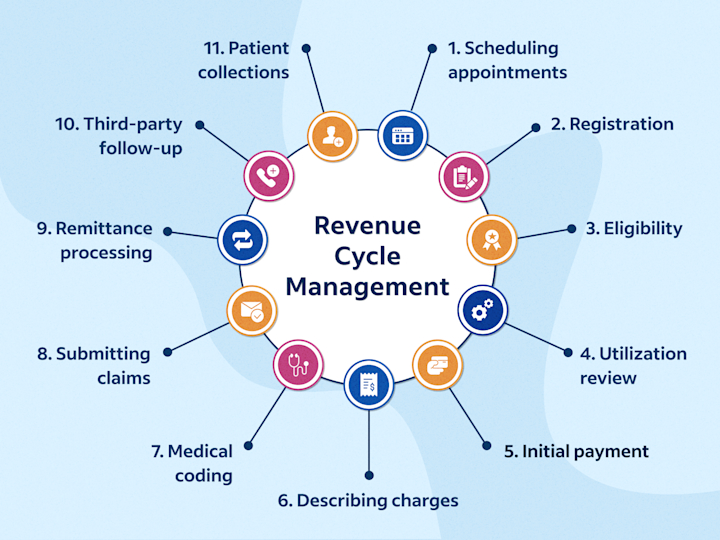
    Revenue Cycle Management refers to the complete financial process healthcare providers use to manage patient revenue. It includes:

    • Patient registration

    • Insurance verification

    • Medical coding and billing

    • Claims submission

    • Payment posting

    • Denial management

    • Accounts receivable follow-up

    When any step fails, revenue loss occurs. That’s why optimizing each stage is critical.

    1. Patient Registration and Eligibility Errors

    One of the biggest RCM challenges starts at the front desk.

    The Problem

    Incorrect patient demographics, outdated insurance information, or missing authorization details often lead to claim denials before billing even begins.

    Common issues include:

    • Wrong insurance IDs

    • Eligibility not verified

    • Missing referrals or authorizations

    • Data entry mistakes

    Even small registration errors can delay payments for weeks.

    The Solution

    • Implement real-time insurance verification

    • Use automated eligibility tools

    • Train front-desk staff regularly

    • Standardize intake workflows

    Preventing errors at the front end significantly reduces downstream billing problems.

    2. Medical Coding Inaccuracies

    Medical coding directly impacts reimbursement accuracy.

    The Problem

    Incorrect CPT, ICD-10, or HCPCS codes can cause:

    • Claim denials

    • Underpayments

    • Compliance risks

    • Audit exposure

    Coding errors often happen due to lack of documentation or outdated coding knowledge.

    The Solution

    • Employ certified medical coders

    • Conduct regular coding audits

    • Use AI-assisted coding software

    • Improve provider documentation practices

    Accurate documentation + correct coding = faster reimbursement.

    3. High Claim Denial Rates

    Claim denials are one of the most costly problems in healthcare revenue cycle operations.

    The Problem

    Healthcare organizations lose billions annually due to preventable denials caused by:

    • Missing information

    • Coding errors

    • Eligibility issues

    • Late claim submission

    Many practices lack structured denial tracking systems.

    The Solution

    • Establish a denial management workflow

    • Track denial trends and root causes

    • Resubmit corrected claims quickly

    • Implement denial prevention analytics

    Top-performing practices focus on denial prevention, not just denial correction.

    4. Slow Accounts Receivable (AR) Collections

    The Problem

    Delayed payments increase AR days and create cash flow instability.

    Common causes:

    • Poor follow-up processes

    • Aging claims ignored

    • Inefficient payer communication

    • Lack of financial accountability

    High AR days indicate revenue being trapped in the system.

    The Solution

    • Monitor AR aging reports weekly

    • Prioritize claims over 30–60 days

    • Assign dedicated AR follow-up teams

    • Automate payment reminders and payer follow-ups

    Reducing AR days directly improves practice profitability.

    5. Inefficient Patient Payment Collection

    Healthcare financial responsibility is shifting toward patients due to high-deductible insurance plans.

    The Problem

    Many practices struggle to collect payments because:

    • Patients are unaware of costs

    • No upfront payment policies exist

    • Limited payment options are offered

    Uncollected patient balances significantly affect revenue.

    The Solution

    • Provide transparent cost estimates

    • Collect copays before visits

    • Offer online payment portals

    • Introduce payment plans

    A strong patient financial experience improves both revenue and satisfaction.

    6. Lack of RCM Technology Integration

    The Problem

    Disconnected systems between Electronic Health Records (EHR), billing software, and practice management tools create inefficiencies such as:

    • Duplicate data entry

    • Billing delays

    • Reporting inaccuracies

    • Workflow confusion

    Manual processes increase administrative burden and human errors.

    The Solution

    • Integrate EHR and billing platforms

    • Use automation for claims submission

    • Implement real-time analytics dashboards

    • Adopt cloud-based RCM solutions

    Technology-driven RCM reduces operational costs and increases efficiency.

    7. Compliance and Regulatory Challenges

    Healthcare billing regulations constantly evolve.

    The Problem

    Failure to stay compliant can lead to:

    • Payment penalties

    • Claim audits

    • Legal risks

    • Revenue loss

    Compliance complexity increases administrative pressure on healthcare staff.

    The Solution

    • Conduct compliance training regularly

    • Stay updated with payer policies

    • Perform internal audits

    • Partner with experienced RCM specialists

    Compliance-focused workflows protect both revenue and reputation.

    8. Limited Revenue Cycle Visibility

    Many healthcare organizations lack clear financial insights.

    The Problem

    Without performance tracking, practices cannot identify revenue gaps.

    Typical missing metrics include:

    • Clean claim rate

    • First-pass acceptance rate

    • Denial rate trends

    • Net collection ratio

    The Solution

    Implement KPI-based reporting such as:

    • Revenue dashboards

    • Predictive analytics

    • Monthly financial performance reviews

    • Data-driven decision-making

    Visibility transforms reactive billing into proactive revenue management.

    Best Practices for Optimizing Revenue Cycle Management

    To overcome RCM challenges effectively, healthcare organizations should focus on:

    • Front-end accuracy
    • Automation and technology adoption
    • Continuous staff training
    • Data analytics and reporting
    • Strong denial prevention strategies
    • Patient-centered billing experience

    Outsourcing Revenue Cycle Management services can also help practices reduce administrative workload while improving collections and compliance.

    Final Thoughts

    Revenue Cycle Management challenges are common across hospitals, clinics, and private practices — but they are solvable. Most revenue problems originate from preventable workflow gaps, outdated systems, or lack of process standardization.

    By strengthening front-end operations, improving coding accuracy, leveraging technology, and focusing on denial prevention, healthcare providers can build a resilient and profitable revenue cycle.

    An optimized RCM process does more than increase revenue — it enhances operational efficiency, reduces staff stress, and ultimately improves patient care outcomes.

  • Benefits of Outsourcing Provider Enrollment and Credentialing Services

    Benefits of Outsourcing Provider Enrollment and Credentialing Services

    In today’s fast-paced healthcare environment, administrative tasks like provider enrollment and credentialing can quickly become overwhelming. The volume of paperwork, constant payer updates, and state-specific regulations often create delays and distractions from patient care. These services are foundational — they enable healthcare practices to bill accurately, stay compliant, and build a qualified care team. When mismanaged, they can disrupt your entire revenue cycle. That’s where outsourcing makes a difference.

    By outsourcing provider enrollment and credentialing services, practices gain access to experienced professionals who understand payer requirements and efficiently handle the process. This not only reduces internal workload but also complements your medical billing services by ensuring that only properly credentialed providers are billing under the correct plans. In this blog, we’ll explore the key benefits of outsourcing — from reducing costs and enhancing accuracy to streamlining reimbursements and enabling your team to focus on patient care.

    Why does Credentialing and Enrollment Seem Difficult?

    Provider enrollment and credentialing are ongoing challenges for any healthcare organization. Every time you onboard a new provider, enter a new payer contract, or go through a re-credentialing cycle, you’re faced with a complex, time-consuming process. It’s not just about submitting applications; it requires consistent follow-ups, thorough documentation, and close attention to changing payer rules and compliance standards. With each update or missed detail, your ability to bill and get reimbursed is at risk. For many practices, this becomes a significant administrative burden that diverts staff from patient care and critical revenue-generating tasks. That’s why more organizations are turning to outsourcing to simplify the process, reduce delays, and ensure everything is handled accurately and on time.

    The Core Benefits of Outsourcing

    Outsourcing provider enrollment and credentialing in medical billing is a strategic move that helps healthcare organizations reduce administrative complexity, enhance compliance, and speed up revenue collection. Here are some of the key benefits you can expect:

    1. Enhanced Revenue Cycle and Reimbursement Rate

    This is usually at the very top of the list. Provider enrollment delays become billing delays. If a new physician is not credentialed with a particular payer, their services simply cannot be reimbursed by that payer. This puts a huge dent in your revenue flow.

    Outsourcing companies provide specialized services. They have existing relationships with payers, know their very specific needs inside and out, and have the know-how to get through the paperwork quickly and efficiently. Their single-minded attention to provider enrollment services allows applications to be submitted faster, followed up on with regularity, and approvals to be obtained in a timely manner. This direct effect on your revenue cycle translates to money coming in sooner, making your organization stronger financially.

    2. Improved Regulatory Compliance

    Compliance is not an option in healthcare. Failing to comply with state, federal, and payer-related credentialing requirements can have severe consequences, including substantial fines, program exclusion, and loss of licensure.

    Companies delivering expert provider credentialing services are immersed in the current regulations. They are up-to-date on all updates, so every bit of paperwork is precise, comprehensive, and filed accordingly. They also conduct rigorous primary source verifications, an important step toward preventing fraud and ensuring patient safety. This careful process decreases your organization’s risk exposure, creating a strong barrier against possible compliance pitfalls. You can rest easy now that your credentialing is in capable hands.

    3. Great Cost Savings

    On the surface, the inclusion of an outside service may appear to be an extra cost. But when you take a closer look, the savings in cost become incredibly apparent. Take a look at the actual cost of handling Enrollment and Credentialing Services internally:

    • Salaries and Benefits: The cost of recruiting, training, and keeping in-house credentialing staff is a huge recurring cost.
    • Software and Resources: You may require special software, secure document storage, and access to several verification databases.
    • Training and Development: Keeping employees up-to-date on the ever-evolving guidelines necessitates ongoing training, which costs time and funds.
    • Lost Revenue: The expense of delayed reimbursement due to sluggish or incorrect credentialing is a concealed but very tangible cost.

    Outsourcing turns these variable, often uncertain, internal expenses into a certain, fixed expense. You pay for a service, not for a whole department. This improves budget forecasting and tends to be a lower total cost for quality service.

    4. Get Access to Advanced and Specialized Credentialing

    Most healthcare organizations lack the funding to employ a complete credentialing staff, each of whom possesses the expertise in a single facet of the process. By outsourcing, you immediately have access to an extensive bench of professionals who think and sleep, provider enrollment and credentialing services. These teams have expert-level knowledge within different payer networks, types of providers, and regulatory settings.

    Furthermore, leading outsourcing firms significantly invest in innovative technology. This includes sophisticated credentialing software, automated verification systems, and secure communication platforms that enable smooth workflows and greater accuracy in data. Such technological advancement is usually out of bounds for solo practices but is made available through outsourcing. You get to utilize their investment in efficiency and accuracy.

    5. Unburden Your Staff for Their Core Competencies

    Perhaps one of the most compelling benefits is the ability to reallocate your internal staff. Picture your administrative staff free from the mundane paperwork and constant follow-up calls pertaining to provider enrollment services. Rather, they can now devote their time to more valuable tasks that directly influence patient care and operational efficiency.

    This frees up your staff to be able to spend more time on scheduling patient appointments and answering phone calls. You now have the billing personnel, who have a focus on difficult claim issues and revenue building. Your management is free to think about strategic growth strategies rather than administrative choke points. By taking this extra non-managerial workload off, you enable your current personnel to work at the level of their licensure and skill set, enhancing job satisfaction and overall organizational performance.

    6. We Scale as You Require

    Healthcare organizations have ups and downs. You could be growing very quickly and hiring a lot of new providers, or maybe consolidating services. Credentialing workload can be extremely tough for an in-house staff to manage during these peak and valley periods.

    Outsourcing offers unmatched scalability. Your own provider credentialing services partner can quickly scale to your requirements, irrespective of your hiring volume. They possess the infrastructure and capacity to manage increased volume without your in-house operations missing a beat. This adaptability is priceless in an evolving healthcare world, enabling you to respond without the cost of recruitment or firing personnel.

    7. Lower Administrative Burden and Stress

    Enrollment and credentialing services can be really stressful. The constant deadlines, mounds of paperwork, and the fear of errors can take a toll on staff morale and cause burnout. By outsourcing, you essentially pass on this strenuous task to a team of experts who deal with these complexities. They do the follow-ups, monitor the deadlines, and sort out the problems. This leaves your staff to concentrate on their core functions, generating a less stressful, more efficient work environment. It’s all about allowing experts to bear the headaches so you don’t have to.

    Choosing the Right Credentialing Partner: The Checklist

    If you are thinking of outsourcing your provider enrollment and credentialing services, the following are a few of the most important factors to keep in mind when selecting a partner:
    Experience and Reputation: Look for a company with a proven track record of success and strong references within the healthcare industry.
    Transparency and Communication: Choose a partner who provides honest updates and maintains open communication. You must always be informed of the status of your applications.
    Compliance Knowledge: Ensure they possess an understanding of relevant state & federal laws, and the payer-specific requirements.
    Technology and Safety: Do they employ secure, cutting-edge technology to protect sensitive patient and provider data?
    Personalization: Can they tailor their services to your unique organizational needs and growth plans?

    Conclusion

    Outsourcing provider enrollment and credentialing isn’t just about saving time. It’s a smart step toward growing your practice. You improve your revenue cycle, stay compliant, and give your staff more time to focus on patient care. In today’s fast-paced healthcare world, accuracy and efficiency are more crucial than ever. Working with a credentialing expert can give your practice the edge it needs.

    Simplify your operations and elevate your practice with Physicians Revenue Group, Inc., your trusted partner for expert provider enrollment and credentialing services. Contact us today to start streamlining your process and enhancing your bottom line.

  • What Is Revenue Cycle Management in Healthcare?

    What Is Revenue Cycle Management in Healthcare?

    Healthcare organizations must balance patient care with financial stability. One of the most important systems that helps providers maintain consistent revenue is Revenue Cycle Management (RCM). Without an efficient revenue cycle, even busy healthcare practices can struggle with delayed payments, claim denials, and revenue loss.

    This guide explains what Revenue Cycle Management is, how it works, and why it plays a critical role in modern healthcare operations.

    What Is Revenue Cycle Management?

    Revenue Cycle Management in healthcare refers to the financial process used to track patient revenue from appointment scheduling to final payment collection. It connects clinical services with billing operations to ensure healthcare providers are properly reimbursed for the care they deliver.

    The revenue cycle begins when a patient schedules a visit and ends when all payments — from insurance companies and patients — are received and recorded.

    In simple terms, RCM ensures healthcare organizations get paid accurately and on time.

    Why Revenue Cycle Management Is Important

    Healthcare billing has become increasingly complex due to changing insurance policies, regulatory requirements, and patient payment responsibilities. An effective RCM system helps practices manage these challenges efficiently.

    Key Benefits of Revenue Cycle Management

    • Improves cash flow and financial stability

    • Reduces claim rejections and denials

    • Speeds up reimbursement timelines

    • Enhances billing accuracy

    • Improves patient financial transparency

    • Ensures compliance with healthcare regulations

    A strong revenue cycle allows providers to focus more on patient care rather than administrative issues.

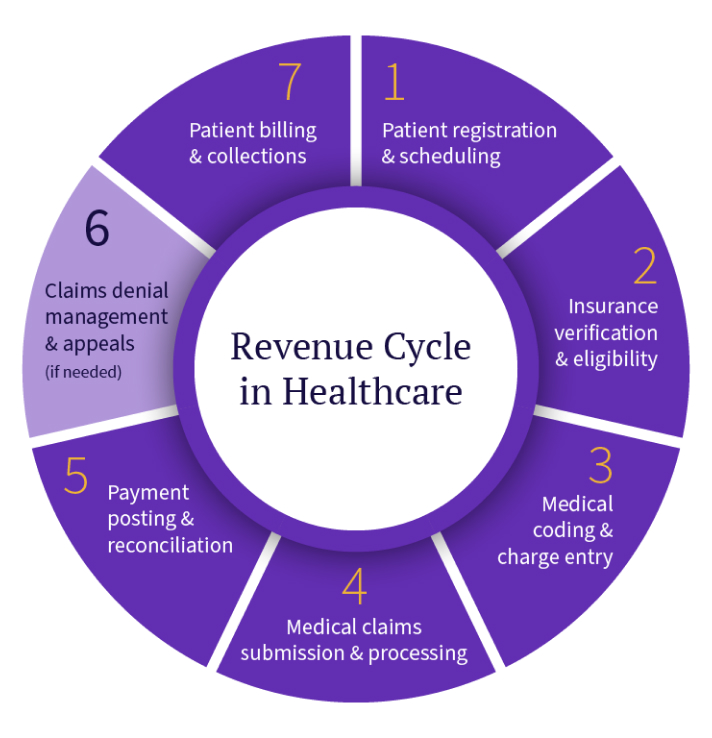
    Revenue Cycle Management involves several interconnected stages:

    1. Patient Registration and Scheduling

    The process starts when a patient books an appointment. Accurate collection of demographic and insurance information is essential because errors at this stage often cause claim denials later.

    2. Insurance Eligibility Verification

    Before services are provided, staff verify insurance coverage, benefits, copayments, and authorization requirements. Proper verification reduces payment delays.

    3. Medical Coding

    Healthcare providers document diagnoses and procedures, which medical coders convert into standardized billing codes such as ICD and CPT codes. Accurate coding ensures compliance and appropriate reimbursement.

    4. Charge Capture

    All services delivered must be correctly recorded and billed. Missing charges directly result in lost revenue.

    5. Claim Submission

    Billing teams submit claims electronically to insurance companies. Clean and accurate claims increase first-pass approval rates.

    6. Payment Posting

    Once insurers process claims, payments are posted into the billing system. This step identifies underpayments and outstanding balances.

    7. Denial Management

    Denied claims are reviewed, corrected, and resubmitted. Effective denial management helps recover revenue that might otherwise be lost.

    8. Accounts Receivable Management

    AR teams follow up on unpaid claims and patient balances to reduce aging accounts and maintain steady cash flow.

    9. Patient Billing and Collections

    Patients receive billing statements for remaining balances. Clear communication improves patient satisfaction and collection rates.

    Common Revenue Cycle Management Challenges

    Healthcare providers frequently encounter obstacles that affect revenue performance.

    Some common RCM challenges include:

    • High claim denial rates

    • Incorrect patient information

    • Coding errors

    • Slow insurance reimbursements

    • Manual administrative workflows

    • Increasing patient payment responsibility

    Addressing these issues requires standardized processes and advanced billing technology.

    Technology has significantly transformed how healthcare organizations manage revenue cycles.

    Modern RCM solutions include:

    • Automated eligibility verification systems

    • AI-powered claim scrubbing tools

    • Electronic health record (EHR) integration

    • Real-time financial reporting dashboards

    • Online patient payment portals

    Automation reduces manual errors, accelerates billing workflows, and improves overall revenue performance.

    Benefits of Outsourcing Revenue Cycle Management

    Many healthcare providers choose to outsource RCM services to specialized medical billing companies.

    Advantages of Outsourcing

    • Access to experienced billing professionals

    • Reduced operational costs

    • Faster claims processing

    • Improved compliance management

    • Better denial prevention strategies

    Outsourcing allows physicians and clinical staff to concentrate on delivering quality care instead of managing complex billing tasks.

    Best Practices to Improve Revenue Cycle Performance

    Healthcare organizations can strengthen their revenue cycle by following proven strategies:

    • Verify insurance before patient visits

    • Maintain accurate clinical documentation

    • Monitor denial trends regularly

    • Automate billing and follow-up processes

    • Track key performance indicators (KPIs)

    • Educate patients about financial responsibility

    Continuous monitoring and optimization are essential for long-term financial success.

    Conclusion

    Revenue Cycle Management is the financial foundation of every healthcare organization. From patient registration to final payment collection, each step directly impacts revenue, operational efficiency, and patient satisfaction.

    An optimized RCM process reduces billing errors, accelerates reimbursements, and ensures healthcare providers maintain a healthy cash flow. As healthcare continues to evolve, adopting technology-driven and patient-focused revenue cycle strategies will be essential for sustainable growth.

    Effective Revenue Cycle Management ultimately enables providers to do what matters most — deliver exceptional patient care while maintaining strong financial performance.